
Leveraging Natural Language Processing for Automated Radiology Coding
New Zealand's public health care system generates approximately 3 million radiology examinations per year. However, multiple different radiology systems and coding structures mean that there is very little consistent information regarding what examinations have been performed, why, how and their outcomes.
Assoc Prof Anthony Doyle explains that part of this relates to the range of information platforms used across HealthNZ | Te Whatu Ora (HNZ|TWO), a situation that will not change for a long time, if ever. The lack of information hampers both proper management of the system and vital clinical audit and research, meaning that answering simple questions regarding clinical practice can take months or years of manually sifting through files.
While working at the Ministry of Health, Anthony and colleagues began exploring the use of Natural Language Processing (NLP) and RATA (RAdiology Text Analysis) was born. The idea was to provide a tool for clinicians, managers, and administrators across our radiology network to meaningfully extract clinical information from free-text radiology reports.
The current team revolves around Danny Hunter-Philpott (Data scientist HNZ|TWO), Craig Roach (System Architect, Amazon Web Services (AWS), and Anthony Doyle (Radiologist, HNZ | TWO).
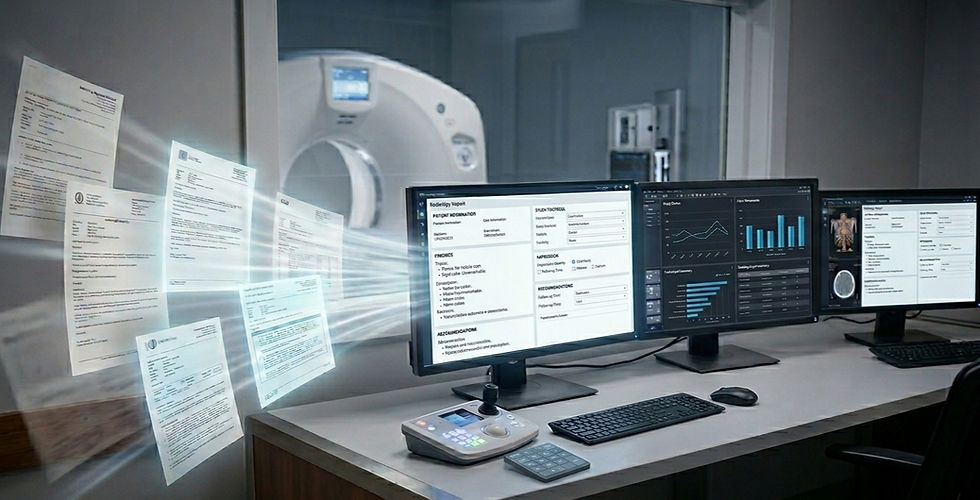
NLP has been used in many healthcare settings; however, many have used bespoke software, which has limited their scope. The team sought a tool that uses widely available processes, does not rely on in-house or bespoke software, is easily updated and can be readily applied to large numbers of reports. RATA uses Amazon Comprehend Medical, an NLP service provided by AWS, to identify clinical language in radiology reports and map it to relevant SNOMED CT codes. Such coding can offer valuable insights into imaging indications, modalities used, and outcomes, thereby supporting clinical care, service planning, and health system improvement
The RATA process is designed as a three-stage pipeline: (1) allocation of a unique, non-identifying report identifier; (2) rigorous de-identification to remove any potentially identifying information from free-text fields; and (3) automated clinical coding using Amazon Comprehend Medical. While the process replicates the interpretive capabilities of a human reviewer at scale and speed, it does not involve generative AI. All processing occurs within secure HNZ |TWO environments, such as Databricks, with data transfer governed by privacy-first protocols.

The team has just published the results of a study where RATA was used to process 220,000 consecutive radiology reports. They took a subset of 941 reports identified as Computed tomography of kidneys, ureters and bladder (CT-KUB) by RATA and further examined its performance in reporting the pathology of renal tract stones (RTS) compared with a manual reference standard (2 expert reviewers).
Of the 220,000 radiology reports processed, RATA successfully templated and analysed 97%. It identified the subset of CT-KUB with an accuracy of 97% and detected RTS as pathology with an accuracy of 95%, sensitivity of 94% and specificity of 97%. The team believes these performance metrics are adequate for clinical purposes.
Anthony sees RATA as having multiple applications across the health system, including:
Identifying patients who may benefit from further management for incidentally detected conditions, such as vertebral fractures or abdominal aortic aneurysms noted on CT scans but not subsequently actioned
Reconciling disparate radiology procedure codes used across the motu
Identifying and quantifying low-yield imaging to better manage scarce resources
Supporting clinical audit activities
Assisting with cohort identification for clinical trials, including trials involving AI tools in imaging
At a national level, the insights generated through RATA also have the potential to support researchers, health managers, and clinicians across a wide range of settings.
It is expected that HNZ |TWO will have all radiology reports on the national data platform later this year, so the team are looking forward to running RATA continuously on these. They're also interested in exploring this approach with other forms of documentation, but they want to take small steps before embarking on more ambitious applications of the principles.
For a full breakdown of RATA's performance, see their recent article: Natural Language Processing of Large Numbers of Radiology Reports in a Public Health System to Extract Structured Data, with a Test Case of CT KUB.
Research Team:
Danny Hunter-Philpott, Craig Roach and Assoc Prof Anthony Doyle
Content Manager:
Nathan Baker, AI in Health Research Network


Comments